2810 N Church St #53470, Wilmington DE 19802, USA

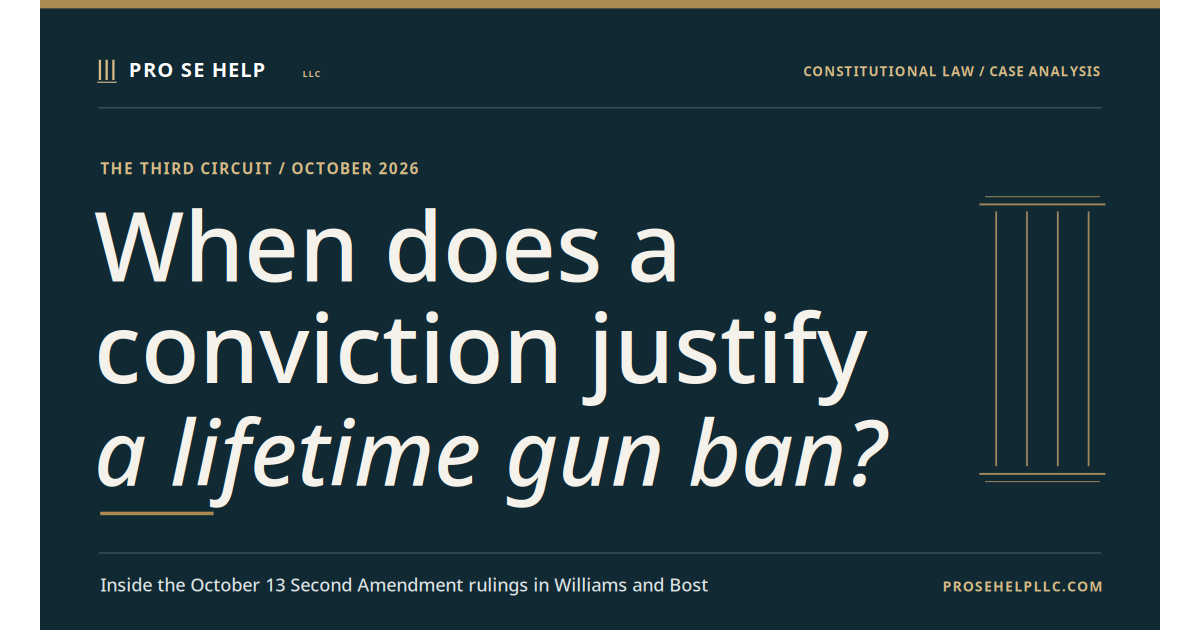
On October 13, 2026, the Third Circuit issued two Second Amendment rulings on the same day. They reached opposite results. Together, they draw a line that matters for anyone with an old conviction wondering about their gun rights.
The cases both challenged the federal law that bans gun possession for anyone convicted of a crime punishable by more than a year in prison. That law is 18 U.S.C. 922(g)(1). It is often called the felon-in-possession ban.
In Williams v. Blanche, the full Third Circuit ruled 8 to 6 that the ban could not be applied to Edward Williams. His record was two drunk-driving convictions from the early 2000s. No violence. No firearm involved. He served his sentence. The court said the government could not show a historical tradition of permanently disarming someone like him.
In the companion case, the same court upheld the ban against James Bost. His record included a carjacking with terroristic threats and false imprisonment. The court said people convicted of crimes showing a risk of physical violence can be disarmed based on those convictions alone.
The court drew the line at dangerousness, not at the label on the conviction. Williams lost his rights over a misdemeanor that theoretically carried up to five years. The label said he was banned for life. The court said the label is not enough. What matters is whether the person's record shows they pose a risk of misusing firearms.
This is an as-applied ruling. That is a legal term worth understanding. The court did not strike down the gun ban for everyone. It said the ban cannot be applied to Williams specifically, given his specific record. Someone with a different record gets a different answer, as Bost learned the same day.
This is not an automatic restoration of gun rights for anyone with a nonviolent conviction. It does not apply outside the Third Circuit, which covers Pennsylvania, New Jersey, and Delaware. And the government will almost certainly ask the Supreme Court to review it.
If you have an old conviction and you are wondering whether this changes anything for you, do not guess. The answer depends on your specific record, your state, and what happens next in the courts. Talk to a lawyer licensed in your state before making any decisions about firearms. Possessing a gun while banned under federal law is itself a federal felony.
A lot of families we hear from have the same question. Someone made a mistake years ago, served their time, rebuilt their life, and now lives under a lifetime ban that feels permanent and unchangeable. Williams shows that courts are starting to ask whether that outcome makes sense in every case. Bost shows the limits. Both are worth understanding.
We will keep watching this. If the Supreme Court takes the case, we will break down what that means in plain language.
Pro Se Help LLC provides legal information and self-help resources. We are not a law firm and this is not legal advice.
Does the Williams ruling restore my gun rights?
Not automatically. The ruling applies to Williams specifically. Whether it helps you depends on your record, your circuit, and what courts decide next. Talk to a lawyer in your state.
Does this apply outside Pennsylvania, New Jersey, and Delaware?
No. The Third Circuit only covers those states. Other circuits may rule differently.
What if my conviction was violent?
The Bost decision shows the ban still holds for convictions involving violence or threats. The court's line is dangerousness.